Why “Follow Your Passion” Is the Worst Advice for Analytical Minds
It is the most repeated career advice on the internet.

It sounds inspiring. It sounds liberating.
But for analytical minds, it is also terrible advice.
By analytical minds, I mean people who make decisions through evidence, iteration, and long-term consequences rather than feelings.
Why is it so terrible?
Because it treats passion like a compass. Something hidden inside you that will magically point to the right path. But analytical people do not make their best decisions that way.
They look for signal.
They test. They observe what compounds over time.
If you think in systems, feedback loops, and long-term compounding, the whole idea breaks.
Passion is usually not the starting point. It is the byproduct.
- You get good at something.
- You see progress.
- You gain leverage.
- The work starts to matter because you are becoming effective at it.
Then passion shows up.
Because passion is not something you discover.
It is something you build.
The Problem With “Find Your Passion”
The popular story says passion is something you uncover.
There is supposedly a perfect craft, career, or calling already inside you, and your job is to find it.
That sounds beautiful. It also collapses under scrutiny. Analytical people notice the contradiction immediately.
- How can you be passionate about something you barely understand
- How can you love a craft you have not practiced?
- How can you feel deep commitment to something you are still bad at?
At the beginning of any meaningful pursuit, you are slow, confused, and incompetent.
Nothing feels natural. Very little feels rewarding. You make mistakes constantly. You usually do not even know how much you do not know.
Being bad never feels like passion.
It feels like friction.
So people misread the early stage.
They assume, “If this were right for me, I would feel energized already.”
But in most cases, they don’t lack passion.
They lack competence.
Curiosity comes first
Curiosity is a far better starting point than passion.
Curiosity says: “This seems interesting. Let me investigate.”
Passion says: “This matters to me. This is part of who I am.”
Those are not the same thing. Both needed, but in the right order.
Curiosity is light.
Passion is deep.
Curiosity gets you to start.
Passion arrives later, after repeated exposure and growing competence.
This matters because analytical people do not need a mystical feeling before they begin.
They need interest to run the experiment.
Explore.
Learn the basics.
Get enough exposure to make an informed judgment.
Without that, “follow your passion” is not advice.
It is just guesswork with branding.
Passion Appears After Competence
When I started programming, I was not passionate about it.
I was curious.
I wanted to understand how things worked.
The beginning was frustrating. Bugs everywhere.
Error messages that made no sense. Tasks that now take seconds used to take hours.
Nothing about that stage felt glamorous.
What changed was not the task.
But my level of competence. After years of practice, the work started to open up.Problems became solvable. Concepts clicked. Patterns became visible.
I was no longer guessing all the time.
I was building. That was the turning point. The work became enjoyable not because it became easy, but because I had become capable.
This is the part people miss.
Competence changes the emotional texture of work. A writer enjoys writing more once they can actually shape a sentence. A carpenter enjoys the craft more once their hands do what their eye intends. A scientist enjoys the field more once the underlying structure starts to become legible.
Much of what people call passion is the feeling of capability meeting challenge.
The Trap of Constant Switching
Most people never stay with one thing long enough to reach competence.
They get excited by novelty. A new field looks promising. A new skill feels fresh. A new identity feels possible.
Then reality shows up.
The work gets hard.Progress slows. Confusion rises. The early optimism fades. This is the dip many people fall into.
It is often described as the “Valley of Despair,” the stage where initial confidence collapses because you finally see how much you do not know.
That is why the Dunning-Kruger curve is relevant here.
The beginning gives inflated confidence because your exposure is shallow. Then deeper contact reveals complexity, and motivation drops.
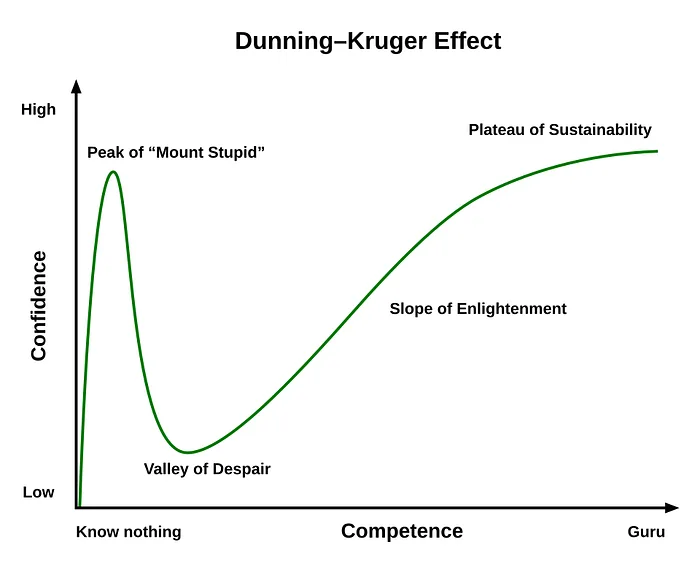
This is where many people quit.
Or worse, switch.
They move to another field, another project, another ambition, hoping the next thing will feel more “aligned.”
But what they are really doing is resetting themselves back to beginner mode.
Again and again. Forever staying in the Valley of Despair.
Life Is Too Short to Restart Forever
Every time you abandon a field too early, you also abandon the compounding that comes with staying.
Compounding in work is not mystical.
It is concrete. You build judgment. You notice patterns faster. You make fewer avoidable mistakes. You meet better collaborators. You develop taste. Your reputation starts working for you.
Small advantages begin stacking. That is compounding.And it usually only appears after sustained effort in the same direction.
Writing compounds. Programming compounds. Sales compounds. Most valuable skills reward time, repetition, and accumulated judgment.
If you keep chasing novelty, you keep interrupting that process.
You may feel stimulated. You will rarely feel fulfilled.
Goals Work Better Than Passion
Goals are more useful than passion because they create direction before emotion arrives.
Goals make decisions easier. Goals filter distractions. Goals turn vague interest into a practical path.
When you know what you are trying to build, random opportunities lose their power.
You stop chasing every interesting possibility. You evaluate options through a clearer lens.
- Does this move me toward the outcome I want?
If yes, it deserves attention.
If not, it is noise.
This is a far better operating system than asking yourself, over and over, what you feel passionate about.
Feelings fluctuate.
Goals stabilize effort.
And stable effort creates competence.
The Real Way Passion Appears
Passion is not discovered like hidden treasure.
It is constructed.
First comes curiosity. Then practice. Then frustration. Then improvement. Then competence. Then, sometimes, passion.
By that point, the craft has become part of your identity.
You care about details. You have taste. You have standards. You notice quality. You want to get better because the work itself has started to matter.
From the outside, people call that passion.
What they see is the visible result of years of effort. So stop waiting for a feeling strong enough to justify commitment.
Follow your curiosity.
Pick a direction.
Set goals.
Stay long enough for the feedback loops to work.
Give competence time to emerge.
Passion might follow.