Why Responsibility Feels Heavy Before It Feels Like Freedom
Chosen responsibility feels heavy before it feels like freedom. Why delayed rewards build self-trust, agency, and a life that feels like yours.
The quiet returns of chosen responsibility, and why most men quit too earl
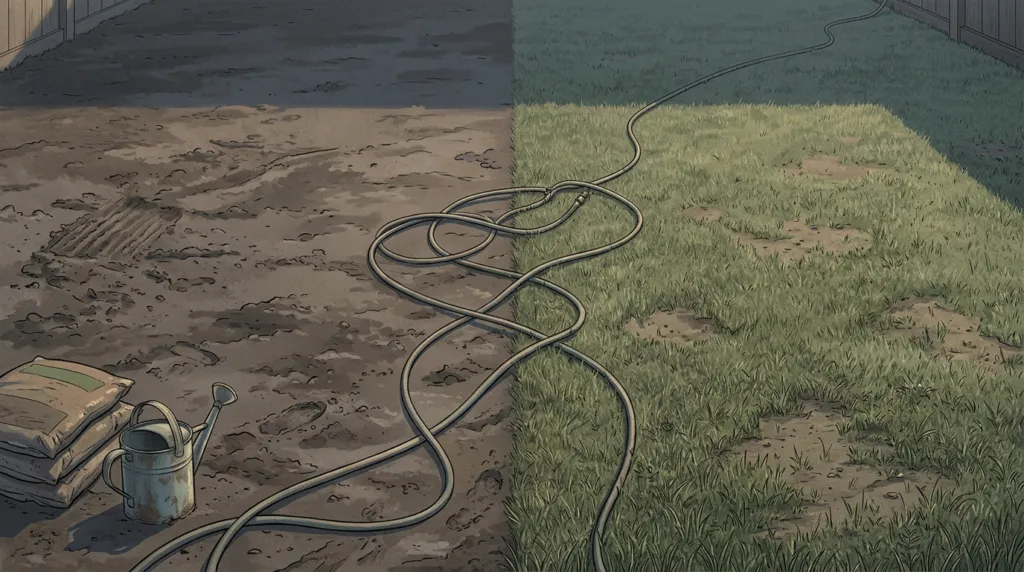
I water the grass every day now.
The garden is big enough that it takes close to an hour. For the first few weeks, that hour gave me almost nothing back. There were some green patches, but mostly dirt and mud. My shoes get drity. The hose gets tangled. The live fence doesn’t shield from prying eyes. And I continued not seeing the results.
But after week 4, it’s started resemlbing a lawn.
This is how responsibility feels at the start. Not noble. Not meaningful. Not empowering. Mostly annoying. Mostly slow. Mostly like you are carrying something that has not yet justified its weight.
This is where a lot of men quit.
They do not quit because they are lazy. They quit because the early phase of responsibility looks effortful. More work. Less freedom. Delayed reward. No applause. No visible payoff.
I understand that reaction because I had it for years.
Responsibility sounded like duty to me. It sounded like less spontaneineity. Less pleasure. Less room to breathe. Even when I knew I needed it, I still felt resistance. Especially after getting sober. Sobriety removed the most obvious form of escape, but it did not automatically turn me into a man who knew how to live. It just made the silence louder.
Why Responsibility Feels Like Pure Burden
That was the harder part.
When you stop numbing yourself, you meet the life you built while you were avoiding it. You also meet the man who built it. In my case, that meeting was not pleasant. I was no longer drinking, but I still carried the same habits of escape, the same weak self-trust, and the same tendency to wait for life to feel clear before I committed to it.
I thought responsibility would trap me.
What I learned is that chosen responsibility is the only thing that has ever made me free.
Not fast. Not dramatically. Not in the first month. But slowly enough that I almost missed it while it was happening.
I became free to follow my goals.
Part of the resistance is simple. Responsibility asks you to accept that the outcome is tied to your behavior. That sounds obvious, but it is heavy when you have spent years protecting yourself with excuses, numbness, or passivity. If the outcome depends on you, then you lose the comfort of blaming other people, your past, your mood, or bad luck.
That comfort is expensive.
It lets you avoid guilt for a while. It also keeps you powerless for much longer.
Why Owning Your Life Can Feel Dangerous
There is something deeper here too. Where I live, a lot of men inherited a lesson from the generations before us. My grandparents and parents lived in a world where standing out could be dangerous. Keeping your head down was not insecurity. It was survival. Do not attract attention. Do not ask for too much. Do not make yourself a target. Stay quiet. Stay safe.
Those conditions changed.
The lesson stayed.
So you grow up with a vague feeling that ownership is risky. Taking responsibility means exposing yourself. If you claim something, you can fail at it. If you care about something, it can hurt you. If you stand for something, you can be judged. It feels safer to drift a little. Safer to stay ironic. Safer to say life just happens.
Until you notice what that safety costs.
You wake up and nothing feels like yours. Your work pays the bills but does not belong to you. Your relationships feel partial because you never fully showed up. Your health reflects your moods. Your plans stay in notebooks. The days pass, but there is no solid evidence that you are building anything.
That kind of life can look fine from the outside.
From the inside, it feels hollow.
Responsibility interrupts that hollowness, but it does not do it with fireworks. It does it with repetition. That is the part people hate. The returns are back-weighted. Month one feels like maintenance. Month six feels different. Month twelve starts to look like a life.
The First Returns Are Quieter Than You Think
This is why the long game is the only game.
If the reward came early, everybody would stay and I’d have nothing to tell you. The whole difficulty is that the early phase gives you just enough evidence to continue, but not enough to feel impressive. You water the grass and still mostly see mud. You write and no one cares yet. You stay sober and still do not know who you are. You show up for your partner and still bring your old fears into the room. You do the thing, but the identity has not caught up.
Still, the early returns are real.
They are just quieter than people expect.
The first return is agency.
When I take responsibility for a problem, I stop being its passenger. The situation may be bad. It may even be partly someone else’s fault. That matters less than one question: what can I do now? The moment I ask that, something changes in my nervous system. The anxiety does not disappear, but it shrinks. I am no longer waiting for reality to improve on its own.
This happened to me over and over after sobriety.
I used to think my anxiety came mostly from life being unstable. Some of it did. A lot of it came from my own passivity. When I was drifting, every problem felt bigger because I was approaching it like a spectator. When I started treating my life as something I had to influence directly, the fear became more practical. Still unpleasant. Much easier to work with.
The second return is self-trust.
Self-trust is not built from affirmations. It is built from evidence. You say you will do something. Then you do it. That is the whole mechanism.
I felt this in small physical ways before I felt it anywhere else. One day I fixed a leaking toilet by myself. This is not a heroic story. It was a practical problem in my flat. But I remember the feeling after finishing it. I was not proud because plumbing is noble. I was proud because I stopped acting like a helpless person waiting for rescue. A small solved problem can change how competent you feel in your own life.
That is how responsibility starts compounding.
You do one thing that used to intimidate you. Then another. Then another. Nothing looks dramatic from the outside, but inside, the data is changing. You are no longer a man who only thinks about doing things. You are a man with proof.
The third return is the reduction of resentment.
Resentment is what grows when you feel life is being done to you. It is quiet, but it poisons everything. It turns work into punishment. It turns relationships into scorekeeping. It turns effort into a favor you think the world should notice.
Chosen responsibility cuts into that.
Not because it makes life fair. Life is still unfair. It changes the posture. When you own the problem, you spend less energy building a case for why you should not have to deal with it. That alone makes life lighter.
What Starts Growing When You Stay
But the long game is not only about early returns.
It is about what grows if you stay.
I can see that clearly only in hindsight.
When I got sober in 2020, I was not building toward fatherhood. I was not trying to create a family. I was not thinking five years ahead. I was trying not to die. That was the scale of my ambition then. Stay sober. Stop destroying myself. Make it through the day without reaching for the old escape.
It was the first responsibility I took seriously enough to keep taking.
Everything that came later grew from that one decision. Not immediately. Not cleanly. I still made mistakes. I still had periods of confusion. I still had to learn how to handle emotions without turning them into a reason to run. But sobriety changed the direction of my life because it forced me into contact with reality. From there, other responsibilities became possible.
I started journaling. I kept exercise simple enough that I could repeat it. I paid attention to what my days were doing to me. I learned to stay in uncomfortable conversations instead of escaping them. I stopped looking for a perfect relationship and started helping build a real one. Over time, those choices produced things I could not have designed in advance.
Now I have a partner I trust. I have a son who needs my steadiness. I have a job I respect. I have a life with shape.
That life was not planned when I started.
It was grown.
And responsibility was the seed.
The Freedom I Wanted Was Too Cheap
This is the part people miss when they talk about freedom. They imagine freedom as the absence of obligation. No constraints. No weight. No cost.
That version of freedom gave me very little.
It gave me drift. It gave me escape. It gave me years of reacting to whatever I felt like doing in the moment. It looked open, but it had no direction. It felt free, but it produced nothing I was proud to protect.
The freedom I value now came from weight.
From being needed. From having commitments. From knowing that some things depend on whether I show up well or badly. That does limit me in the short term. Of course it does. I cannot do whatever I want whenever I want. But my life is better now in every way I care about.
And it is a trade.
You give up short-term options. You gain a life that starts to feel like yours.
There is another thing that happens when you stay with responsibility long enough. You begin to care more because you invested effort. People think they should feel attached first and then commit. In many parts of life, it works the other way around. You commit first. Attachment grows from the care.
That is what happened with the garden.
At the start, I watered dirt. Later I started noticing the small green areas. Then I caught myself looking at them with satisfaction. Not because the grass was extraordinary, but because I had put something into it every day. The effort changed the relationship.
The same thing happened with my life.
I did not suddenly discover a meaningful life waiting for me somewhere. I became attached to the life I was building because I was helping build it. Responsibility created the bond.
How To Stay In The Work Before It Pays Back
So how do you stay when the progress is still invisible?
You make the responsibility small enough to repeat.
The grass does not care whether I water it with passion. It cares whether I water it. Your journal does not care if you feel deep. Your run does not care if you feel inspired. Your partner does not need a perfect speech every day. The minimum version done consistently is worth more than the ideal version imagined.
You also track evidence, not outcomes.
Outcomes are slow. Evidence is available today. Did you show up or not? Did you keep your word or not? Did you take one action that reduced the distance between the man you are and the man you say you want to be? That is enough data for one day.
And you attach the responsibility to something real.
Vague responsibility becomes burden fast. Specific responsibility can hold. I can do hard things more easily when I know who or what they serve. Sometimes that is my son. Sometimes it is my relationship. Sometimes it is simple self-respect. The point is that the effort needs an object. Otherwise it feels like punishment.
This is also where objections show up.
You may think responsibility sounds like obligations you do not want. Sometimes that is true. Not every burden is worth carrying. This only works when the responsibility is chosen and connected to something you care about.
You may think the returns are too slow. They are slow. That is why you need to look for evidence, not transformation.
You may think you already carry enough responsibility at work. Maybe you do. But responsibility for outcomes you do not care about will not create attachment to your life. It will only make you tired.
Test This In One Area This Week
You probably already know the area of your life where this applies.
It is usually the place where you keep explaining instead of acting. The place where you keep building a case against ownership. The place where you still want freedom without the weight that makes freedom real.
Maybe it is your health. Maybe it is sobriety. Maybe it is a relationship you keep blaming on incompatibility while refusing to show up honestly inside it. Maybe it is work that frustrates you because you never fully claimed your own development. Maybe it is the general feeling that your life has been happening around you and you are tired of watching it.
Do this today:
Pick one area where you have been acting like a passenger. Write one sentence: “what would a person who own it fully do?” Then do the smallest version of that answer asap.
Repeat this for 7 days:
Keep a simple evidence log. One line each evening: what did I show up for today that I did not feel like doing?
Journal on this question:
Where in my life am I creating excuses to not act instead of building proof that I can?